
The apprenticeship gap: How will investment professionals develop judgement in the age of AI?

Author: Sylvia Solomon, ASIP
Few investment professionals look back fondly on the hours spent cleaning data, rebuilding models or discovering, three minutes before an investment committee meeting, that the numbers on page seven did not agree with those on page twelve.
AI promises to spare the next generation much of that labour. There is no virtue in inefficiency for its own sake, and nobody’s professional development need depend upn mastering the art of repairing a spreadsheet at midnight.
But an awkward question is hiding inside the productivity gain: what if some of the work we are so pleased to eliminate was also how people learned to think?
The junior analyst’s spreadsheet was never just a spreadsheet. It was an apprenticeship in disguise.
The work was doing two jobs
For decades, early-career investment professionals learned through the work itself. They gathered information, reconstructed accounts, tested assumptions, reconciled
inconsistencies and watched apparently convincing arguments collapse under an experienced colleague’s questioning. I entered the profession in an era when much of what later came to be called judgement was acquired experientially, through repeated exposure to uncertainty, challenge and, inevitably, mistakes.
Much of this was routine, tedious and rarely designed or labelled as developmental. Yet the work was doing two jobs at once. It produced the analysis the organisation required, but it also formed the analyst who produced it.
Through repetition, junior professionals began to recognise what looked unusual. Through error, they discovered which assumptions mattered. Through challenge, they
learned that a plausible answer was not necessarily a sound one. Gradually, and often imperceptibly, they developed the scepticism, pattern recognition and professional instinct upon which more senior judgement would later depend.
We thought we were paying junior analysts to produce the work. In part, we were paying them to become the people capable of judging it.
AI changes this arrangement. It can now perform, accelerate or substantially assist many of the tasks through which professionals once acquired their craft. The immediate benefit is easy to measure: more output, produced more quickly and at lower cost.
What is harder to measure is what may no longer be learned along the way.
Productivity before proficiency
The evidence that generative AI can improve workplace productivity is persuasive. It can help less experienced people perform certain tasks more quickly and, in some cases, produce work closer in quality to that of stronger colleagues.
For employers, this is understandably attractive. A junior professional who can analyse a large body of information, produce a credible briefing note and construct a polished presentation in a fraction of the previous time appears to have become productive remarkably quickly.
But organisational productivity and individual proficiency are not the same thing.
AI may enable someone to produce work bearing many of the outward characteristics of expertise: assured prose, immaculate presentation, plausible analysis and a confidently expressed recommendation. Unfortunately, resemblance is not the same as judgement.
Indeed, the polish creates a new difficulty. Previously, imperfect work often revealed imperfect understanding. A missing calculation, muddled argument or poorly supported conclusion gave a supervisor clues about where the individual was struggling. The workings were visible.
AI can clean away many of those clues. It does not merely risk concealing mistakes; it can conceal the stage of development of the person making them.
This matters for supervision, promotion and trust. If managers see only increasingly accomplished outputs, how will they know whether the person presenting them understands the reasoning, can identify its limitations or could reproduce the judgement when the technology is wrong?
The easier AI makes it to review the finished product, the harder it may become to assess the unfinished professional.
When the world refuses to behave
AI’s capabilities have been described as having a “jagged frontier”: a model may perform brilliantly on one task and prove unexpectedly unreliable on another that appears little different. Fluency can make that unevenness difficult to detect. The answer does not necessarily become more hesitant as it becomes less dependable.
Investment adds a further complication. Markets are not controlled environments, and the future is not always a more computationally demanding version of the past.
Relationships change. Regimes shift. Incentives distort behaviour. Political decisions alter the rules. Historical evidence can become least useful at precisely the moment confidence in it is greatest.
Prediction asks what usually follows. Judgement asks whether this occasion is different, and whether acting on the answer would be right.
Beyond technical competence, professional judgement requires the ability to recognise what the available data cannot settle: whose interests are being served, which risks are tolerable and when an apparently attractive opportunity should nevertheless be declined.

That distinction becomes especially concrete around an investment committee table. A model may identify the portfolio that appears optimal. Trustees must still ask whether its assumptions are credible, whether its risks are tolerable and whether the proposed course is right for the pension scheme and the people whose retirement savings depend upon it.
Those trustees cannot answer members by saying that the model seemed confident.
A model may help identify the options. It cannot bear fiduciary responsibility for choosing among them.
Trust begins with accountability
Much of the conversation about AI starts with the technology. I think it should start with trust. Clients do not ultimately ask whether an algorithm produced part of the analysis. They ask something much simpler: who is accountable? Ultimately, someone still has to settle the bill.

That question is not necessarily answered by placing a person somewhere in the workflow and describing the arrangement as “human in the loop”. I have always
preferred “human-centred”. One sounds like a control mechanism. The other describes responsibility.
A human-centred approach begins with the client and the purpose of the decision. Technology may examine evidence, challenge assumptions and reveal alternatives, but responsibility for interpreting that evidence, understanding its limitations and deciding what should be done still rests with someone who can carry a fiduciary duty. Accountability cannot be delegated to something that can hold no duty in law or bear one in conscience.
The familiar reassurance is that AI will support rather than replace professionals, with a human remaining “in the loop”. But is there really a human in the loop, or merely one near the end of the process? Meaningful oversight requires the knowledge to recognise a plausible error, the independence to challenge a fluent recommendation, the confidence to override it and the experience to understand the consequences.
If AI has displaced part of the apprenticeship through which those qualities were developed, placing a person at the approval stage cannot supply the judgement that was never formed upstream.
A human in the loop is not necessarily judgement in the loop.
There is also the small matter of automation bias. Once a system looks impressive, challenging it can feel inefficient, awkward or even presumptuous. The more polished its output, the more easily review slides into confirmation. Human oversight survives in form while diminishing in substance. The risk is not simply that we have no humans in the loop, but that they stop using the judgement the loop was meant to rely on.
For professional bodies such as CFA UK, the challenge is not only to explain AI, but to help members preserve and demonstrate the judgement on which trust depends.
AI as a sparring partner
None of this makes AI the enemy of professional judgement. Used well, it could become one of its most useful sparring partners.
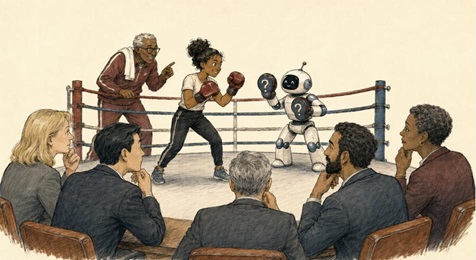
AI can test an argument, construct the strongest opposing case, expose an overlooked assumption or ask the uncomfortable question a supportive team has quietly avoided. It can help professionals explore unfamiliar scenarios and distinguish what they know from what they have merely repeated often enough to believe.
But a sparring partner is valuable because it sharpens the person doing the thinking, not because it relieves them of the need to think. The challenge, then, is not that AI eliminates apprenticeship altogether, but that it changes its form so quickly that professions must become more deliberate about how judgement is cultivated.
That suggests a richer role for AI in professional development. Instead of using it only to produce answers, we can use it to provoke questions. Analysts might be required to challenge its conclusions, identify the conditions under which they would fail and defend the circumstances in which they chose not to follow them. Increasingly, the evidence of capability may lie not in whether someone can obtain an answer, but in how they question and test it.
Designing the next apprenticeship
The aim is not to preserve inefficient work for its own sake. Removing every hill from athletic training would be unhelpful, but that does not mean manufacturing pointless ones. The better response is to identify the learning embedded within the work and reproduce it more effectively.
Medicine offers a useful parallel. Clinical judgement develops through supervised practice, varied and ambiguous cases, progressive responsibility and reflection on
decisions and their consequences. The profession attends not only to the judgement it expects of an experienced clinician, but also to the experiences through which it is formed and observed.
Judgement was not formed merely by completing difficult tasks; it was shaped socially through being questioned, observing experienced colleagues, defending decisions and gradually absorbing the standards of a professional community.
CFA UK has a distinctive role in this. By convening practitioners across firms, disciplines and generations, we can create intellectually demanding environments in which assumptions are challenged, experience is shared and judgement is practised rather than merely discussed. Credentials must also continue to provide confidence in something deeper than polished output: knowledge, ethical reasoning, discernment under uncertainty and the capacity to defend decisions whose consequences affect others.
Professional community is not peripheral to the formation of trusted professionals; it is one of the conditions that makes such formation possible.
Investment may need to become equally deliberate. Supervised simulations, ambiguous case studies and exercises in which AI produces a plausible but incomplete answer could require professionals to expose their assumptions, defend their reasoning and explain what evidence would change their minds. Experienced colleagues would remain central, spending less time correcting production and more time making judgement visible.
The market is unlikely to keep paying a premium just for processing information. It will value those who know what deserves attention, what requires challenge and when apparent precision should not be mistaken for truth.
AI may give the profession more sophisticated tools, faster analysis and fewer visible errors. All would be welcome. Whether it will leave us with enough people clients can trust to know when not to rely upon those tools is a different question.
The answer is not to bring back the drudgery. It is to recover deliberately what the drudgery happened to teach, while keeping responsibility unmistakably human.

ABOUT OUR CHAIR
Sylvia Solomon, ASIP, IMC is Chief Investment Officer at Dhow Capital Group, where she leads strategy in global commodities trade finance. With over 30 years of investment industry experience, she has held senior roles in FCA-regulated firms and managed diverse portfolios including pensions, endowments, and alternative investment funds. Sylvia serves on several influential boards, including the CFA Society of the UK and the University of Aberdeen Investment Committee, and advises the Impactable Investment Group on institutional-scale impact investing.
A trailblazer in sustainable finance, Sylvia was the inaugural Chair of the CFA Institute ESG Advisory Panel, spearheading the development of the CFA Institute Sustainable Investing Certificate—the UK’s first professional ESG qualification. She chairs the CFA UK Examinations and Education Committee, overseeing key industry certifications, and contributes to global policy through roles with the UN PRI and AIMA. Her leadership in education and responsible investing earned her the CFA Institute’s 2022 Inspirational Leader Award.
Related Articles