
The bell still rings: Lessons in risk, resilience and institutional memory

Authors: Sylvia Solomon, ASIP & Monik Mehta, CFA
In January 1912, brokers walked into Lloyd’s carrying an exceptionally attractive risk: the largest and most technologically advanced passenger liner ever built. It was a triumph of engineering, ambition and publicity. As it turned out, it was also a poor candidate for immortality.
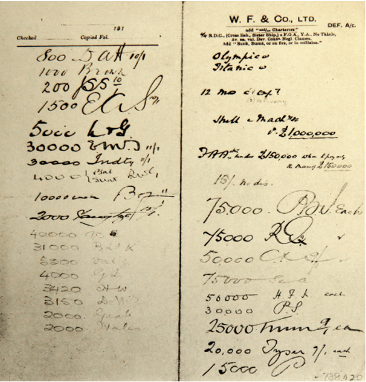
Figure 1. Titanic Placement Slip, Lloyd’s, January 1912
"Practically unsinkable" was the kind of phrase that can make careful people feel slightly careless.
Three months later, in the freezing darkness of the North Atlantic, a lookout rang the warning bell and called, with history’s neatest possible understatement, “Iceberg, right ahead.” Within hours, the RMS Titanic had vanished beneath the waves.
Lloyd’s survived because it was built to absorb loss rather than deny it. The White Star Line, owner of the Titanic, was paid in full within 30 days. When Lloyd’s opened for business the next morning, it did so amid conflicting reports, sharply changing reinsurance prices and a good deal of uncertainty. The system held.
The Myth of the Unsinkable
In every era, investors persuade themselves that one asset, sector or theme is different from the rest. In 1912 it was Titanic; in other periods it has been railways, the Nifty Fifty, dot-com stocks, structured credit, crypto and, more recently, artificial intelligence. The names change. The psychology does not.
Investors are especially vulnerable to stories that arrive dressed as certainty, because certainty flatters judgement. It allows people to mistake confidence for clarity.
Markets do not only price cash flows and risk; they also price conviction, fashion and the appetite for reassurance. Titanic was not merely a ship. It was a story.
Eggs and Baskets
Lloyd’s shows how risk was shared. The Titanic and her sister ship Olympic were insured for £1 million each; the slip opened on 9 January 1912 and was completed within days, with some 12 companies and more than 50 Lloyd’s syndicates participating in the risk. Underwriters took portions ranging from £200 to £75,000. The market did not “take a view” so much as distribute one.
It is easy to overlook how often concentration is mistaken for conviction, especially when performance still looks benign.
The contemporary parallel lies in private credit syndication, secondary risk transfer, insurance-linked securities and catastrophe bonds, together with the broader capital-market habit of separating origination from ownership. Lloyd's in 1912 was an expression of the same principle: resilience achieved through institutional design rather than heroics. .
|
Historical Observation |
Contemporary Analogue |
Investment Lesson |
|
A single, seemingly exceptional risk was distributed across multiple underwriters rather than concentrated on one balance sheet. |
Private credit syndication, insurance-linked securities, catastrophe bonds and broader capital-market risk transfer. |
Diversification is a structural design choice, not a slogan.Resilience improves when no single participant bears the entire loss. |
|
The market continued to function while information remained incomplete, contradictory and rapidly evolving. |
Markets processing breaking news, analyst research, social media, algorithmic trading signals and AI-generated commentary. |
Professional judgement lies not in certainty, but in disciplined adaptation.It is measured by the willingness to revise beliefs as evidence evolves. |
|
Lloyd's settled the claim because the market had been designed to absorb losses. |
Liquidity management, operational resilience, stress testing, collateral frameworks and contingency planning. |
Liquidity and resiliencecreate room for manoeuvre. Their value is realised precisely when conditions deteriorate. |
|
OVERARCHING THESIS |
||
|
Resilient institutions are built on the assumption of fallibility, not infallibility. |
||
Figure 2. Then and Now: Why the Titanic Still Matters to Investors
Signal and Noise
On the morning of 15 April, reports were contradictory: Titanic had struck an iceberg; Titanic was sinking; Titanic was under tow and safe; Titanic was lost. Reinsurance rates rose sharply, then fell again as new information emerged. This was not irrationality for its own sake. It was a market attempting to price uncertainty before the facts had settled down.
Investors today are surrounded by fragments: headlines, analyst notes, social media, algorithmic commentary and an increasingly persuasive stream of machine-generated certainty. The challenge is distinguishing signal from noise before the noise has finished clearing its throat. Professional judgement lies less in accurate forecasting than in intelligent updating as new information emerges.
Volatility is the visible expression of uncertainty that already exists beneath the surface. Volatility is the wake. The iceberg is the event.
The question is whether investors can make sound decisions while knowing less than they would like. That is where process, governance and temperament become genuine sources of value.
Liquidity and Survival
Liquidity is seldom celebrated in advance, but it becomes indispensable in extremis. Investment risk arises not only from owning the wrong asset, but also from holding the right one in the wrong liquidity structure. A portfolio can be sound and still be stranded.
Titanic was a tragedy of insufficient lifeboats and of assumptions about safety, speed and margin for error. When markets seize up, financing disappears or exits become crowded, the issue is rarely just pricing. It is survivability.
Lloyd’s lesson lies not in the loss itself, but in the structure that absorbed it. Today’s parallel is syndication, secondary markets, collateralised structures and institutional processes that preserve flexibility when conditions deteriorate. True resilience is elastic: the capacity to absorb strain without buckling.
Resilience by Design
Lloyd's was built to endure. Its structure assumed large losses were possible, spread them across many participants and kept working when the shock arrived. Resilience depends upon confidence that counterparties remain able and willing to perform when called upon. Institutions can be designed to remain functional when mastery proves elusive.
Stress testing, liquidity management, scenario analysis, and operational resilience are the investment equivalent of watertight compartments: not defensive afterthoughts, but essential features of resilience.
Resilient institutions are well architected. They distribute risk, preserve liquidity, maintain credible counterparties, align incentives and build challenge into decision-making before the shock arrives.

Figure 3: From Placement to Payout: A Timeline of Risk, Resilience and Response
Humility Without Panic
A serious investor does not need to be gloomy. Nor, fortunately, does one need to be permanently wearing a risk committee expression. The lesson is not to distrust innovation, but to recognise that innovation and vulnerability have always travelled together.
Titanic was a technological marvel. So were many of the market themes that later travelled with great speed into disappointment. The internet transformed the world; many internet stocks did not survive to enjoy the experience. It is a reminder that investors must distinguish enduring value from a persuasive narrative with good lighting.
Institutional humility is less about caution than about preparedness. Humble institutions encourage dissent, challenge prevailing narratives and preserve the flexibility to revise their views as new evidence emerges. That kind of humility does not weaken conviction; it gives conviction somewhere to stand.
What Endures
Every era manufactures at least one unsinkable asset. The labels evolve. The instinct does not. Perhaps John Kenneth Galbraith captured the phenomenon best in Money: Whence It Came, Where It Went, “Somewhere, at any given moment, investors are congratulating themselves that this time is different. History is seldom rude enough to agree”.
The Lutine Bell hangs in Lloyd's underwriting room. It is an ornament with an argument. Investors would do well to regard it as something more than maritime décor.
“A portfolio can be sound and still be stranded.”
Selected References and Further Reading
The themes explored in this article draw on a body of literature spanning behavioural finance, risk, resilience and decision-making under uncertainty. Readers wishing to explore these ideas further may find the following works of interest.
Historical and Insurance Sources
- Lloyd’s. How the Market Works: Insuring the Titanic; The Titanic; Lloyd’s and the Titanic.
- Howden Re. A Secondary Market for Reinsurance; Re-balancing.
- Guy Carpenter. Capital Markets: The Reinsurance Evolution Continues.
- Willis Re. Reinsurance Market 2.0.
Behavioural Finance, Risk and Decision-Making
- Bernstein, Peter L. Against the Gods: The Remarkable Story of Risk. John Wiley & Sons, 1996.
- Galbraith, John Kenneth. Money: Whence It Came, Where It Went. Houghton Mifflin, 1975.
- Kahneman, Daniel. Thinking, Fast and Slow. Penguin Books, 2011.
- Marks, Howard. The Most Important Thing: Uncommon Sense for the Thoughtful Investor. Columbia University Press, 2011.
- Perrow, Charles. Normal Accidents: Living with High-Risk Technologies. Basic Books, 1984.
- Shiller, Robert J. Irrational Exuberance. Princeton University Press, 2000.
- Shiller, Robert J. Narrative Economics: How Stories Go Viral and Drive Major Economic Events. Princeton University Press, 2019.
- Silver, Nate. The Signal and the Noise: Why So Many Predictions Fail, But Some Don’t. Penguin Press, 2012.
- Taleb, Nassim Nicholas. Antifragile: Things That Gain from Disorder. Random House, 2012.
- Taleb, Nassim Nicholas. The Black Swan: The Impact of the Highly Improbable. Penguin Books, 2007.
Postscript
This article owes its origins to a conversation rather than a research project.
At CFA UK's Summer Reception, I met Monik Mehta, who introduced himself as an insurance professional and newly qualified CFA Program Level III candidate. Mentioning that the insurance sector had been the first I covered as a Portfolio Manager led to a fascinating discussion about Lloyd's of London and, shortly afterwards, Monik kindly shared a remarkable historical manuscript relating to the insurance of the Titanic. A week later, I had the privilege of presenting Monik with his CFA Charter.
It seems fitting that an article about institutional memory should itself have grown from a conversation between members at different stages of their professional journeys. One of the Society's greatest strengths is that conversations begun over a reception can, occasionally, become collaborations.

ABOUT OUR CHAIR
Sylvia Solomon, ASIP, IMC is Chief Investment Officer at Dhow Capital Group, where she leads strategy in global commodities trade finance. With over 30 years of investment industry experience, she has held senior roles in FCA-regulated firms and managed diverse portfolios including pensions, endowments, and alternative investment funds. Sylvia serves on several influential boards, including the CFA Society of the UK and the University of Aberdeen Investment Committee, and advises the Impactable Investment Group on institutional-scale impact investing.
A trailblazer in sustainable finance, Sylvia was the inaugural Chair of the CFA Institute ESG Advisory Panel, spearheading the development of the CFA Institute Sustainable Investing Certificate—the UK’s first professional ESG qualification. She chairs the CFA UK Examinations and Education Committee, overseeing key industry certifications, and contributes to global policy through roles with the UN PRI and AIMA. Her leadership in education and responsible investing earned her the CFA Institute’s 2022 Inspirational Leader Award.