
Top financial scandals and lessons for investors and analysts - Part 2

Author: Andrew Haskins, ASIP
Satyam (India, 2008-2009): pretending there is cash in the bank
Satyam Computer Services was one of India's largest IT groups in the 2000s and a major provider of outsourcing services. The word “satyam” means “truth” in the ancient Indian language of Sanskrit, but in reference to this company it clearly meant the opposite.
From about 2000 onwards, the top leadership of Satyam falsified the accounts, inflated the share price, and stole large sums from the company. The scandal was exposed in January 2009, resulting in a 99% fall in the company’s market value and its acquisition by a rival.
At the time, I was based in Hong Kong, and I had recently been made redundant as a senior pan-Asian equity analyst during the Global Financial Crisis. With more time on my hands, I had the opportunity to investigate equity stories across different sectors and markets. The Satyam scandal was fascinating.
Satyam’s Chairman, B. Ramalinga Raju, admitted the fraud in a letter to the company’s Board of Directors. His letter was very precise. As of 30 September 2008, Satyam’s balance sheet had been bolstered by the inclusion of INR5,040 crore (INR50.4 billion, or about US$1.09 billion at the exchange rate at the time) of “inflated (non-existent) cash and bank balances”.1
The letter further revealed that Satyam’s revenues and profits had been overstated, that what was originally a “marginal gap” between actual and reported operating profit had ”attained unmanageable proportions” as the company continued to grow, and that the Chairman and Managing Director had been trying without success to make an acquisition that would “fill the fictitious assets with real ones”.
The letter stated further that the fraud had been carried out at the level of the parent company, and that the books of the subsidiaries were clean.
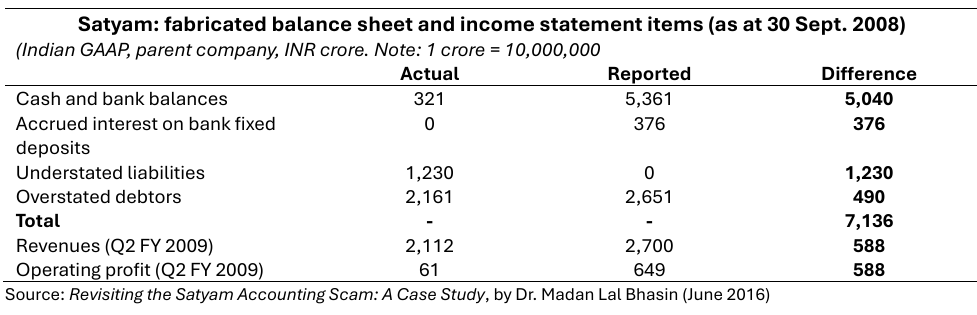
Treating the balance sheet at face value
While there were other aspects to the Satyam scandal, the core of the fraud was the non-existent cash.
Remarkably, when the scandal was admitted, Satyam claimed that it held about US$1.04 billion in “non-interest-bearing” deposits. This situation was widely known. Indeed, according to possibly apocryphal stock market legend, a public meeting between Satyam and investors and analysts helped to expose the fraud.
Supposedly, one perceptive analyst at the meeting enquired why the company held so much cash in non-interest-bearing accounts, and the top management refused to reply. The true answer, of course, was that the reported cash levels were largely fictitious.
The fact that Satyam claimed to hold so much cash in non-interest-bearing deposits was an obvious red flag. As noted in academic comment on the scandal, most accounting professionals would argue that any reasonable company with large excess cash balances should either look for some way to achieve a return on the cash or give it back to shareholders.2
To have cash balances lying around without even generating interest income is a clear signal for auditors to investigate the company’s behaviour.
Yet Satyam’s auditors, PwC India, never did so. Indeed, the maintenance of this simple accounting fraud over many years raised serious questions about that firm. Best audit practice demands direct confirmation of cash balances from banks, but PwC India simply accepted bank statements handed over by Satyam staff, without verifying them independently.3
Wirecard (Germany, 2019-2020): history repeating itself
The essence of the Satyam fraud was very similar to a central element of the Wirecard scandal in Germany in 2019-2020. This scandal led to the insolvency of Wirecard, a once high-flying payment processing company which was worth more than EUR24 billion at its peak in 2018.
Wirecard claimed to hold large cash balances – around EUR1.9 billion – which essentially did not exist. There were many other aspects to this equally fascinating scandal, but here let us focus on the non-existent cash.
As with Satyam, Wirecard’s long-time auditor, the German operation of EY, failed to verify the existence of cash reserves in what appeared to be fraudulent bank statements. Specifically, for more than three years, EY failed to request crucial account information from a Singapore bank in which Wirecard claimed to have deposited cash.4
The scandal was eventually fully exposed by a combination of diligent analysis by hedge funds and other investors, and dogged reporting, especially by journalists of the Financial Times.
Perhaps the key lesson of both these scandals is that for investors is that one cannot rely on certification of accounts by external auditors. PwC India had given Satyam’s accounts a clean bill of health for years, while EY had failed to investigate Wirecard’s cash balances properly even though questions had been raised about the company’s accounts and controls as early as 2008.
Investors need to do their own homework and look out for obvious red flags such as holding high levels of cash in non-interest-bearing accounts.
To follow
Part Three
Chinese residential property crash (c.2019 onwards): beware the obvious flaw in the underlying business model
1 As cited in “Revisiting the Satyam Accounting Scam: A Case Study” by Dr. Madan Lal Bhasin, Professor, School of Accountancy, College of Business, Universiti Utara Malaysia, Sintok, Kedah Darul Aman, Malaysia (June 2016).
2 See, e.g., Indian Journal of Legal Review, “A Case Study of Satyam Scam and Corporate Governance Issues (Volume 5 and Issue 6 of 2025), by Anisha Mishra and Dr Reshma Umair, Amity Law School, Lucknow.
3 See https://www.linkedin.com/pulse/anatomy-satyam-scam-brutal-lesson-auditors-corporate-world-agrawaln6i5c.
4 See “Germany to overhaul accounting regulation after Wirecard collapse” (Financial Times, 28 June, 2020).
ABOUT THE AUTHOR
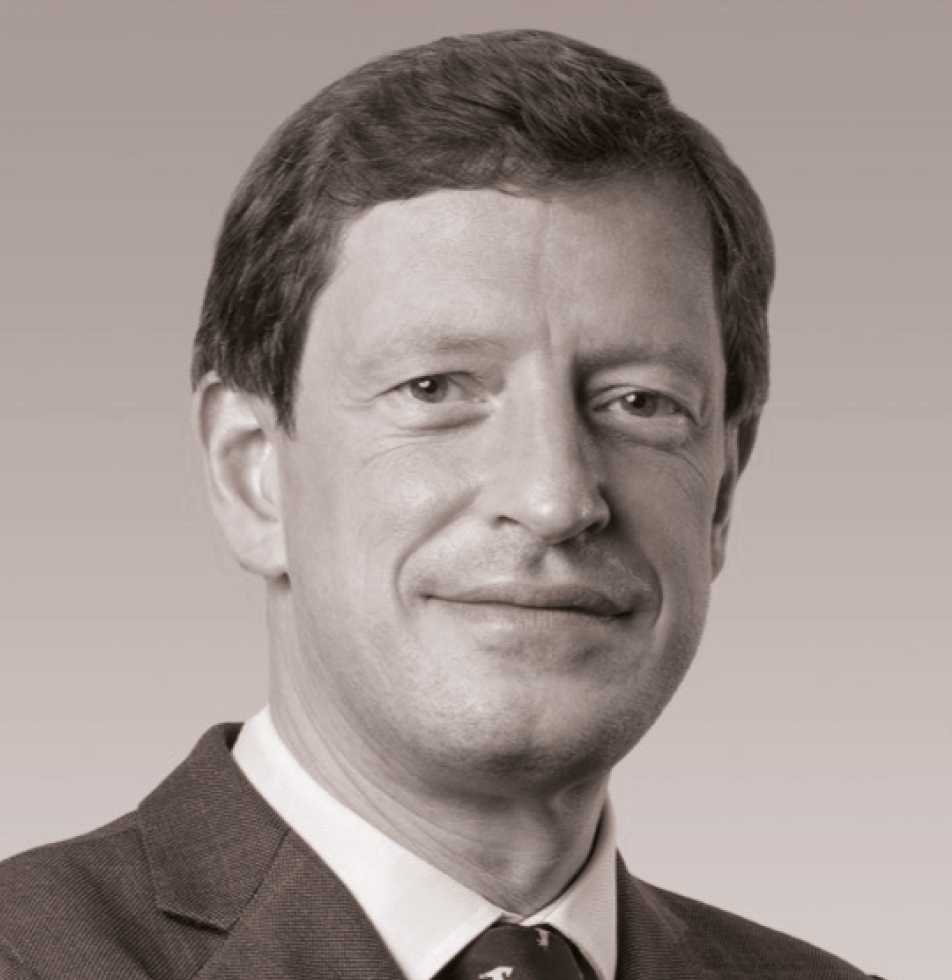
Andrew Haskins has over 35 years of financial experience across multiple markets and sectors. He spent 25 years as a senior equity analyst or head of equity research for investment banks including HSBC, Nomura and MUFG based in London, Paris, Tokyo, Riyadh and Hong Kong. Thereafter, Andrew moved into private real estate, spending eight more years in Hong Kong as head of Asia research for Colliers International and head of APAC real estate strategy for Schroders Capital. He then returned to the UK and worked for two years in corporate finance.
A holder of the ASIP designation, Andrew has twice been a Responsible Officer under the rules of the Hong Kong Securities and Futures Commission. A strong presenter and prolific writer, he is proficient in French and Japanese, and holds BA and MA degrees in Law and Japanese Studies from Cambridge University.
Related Articles